
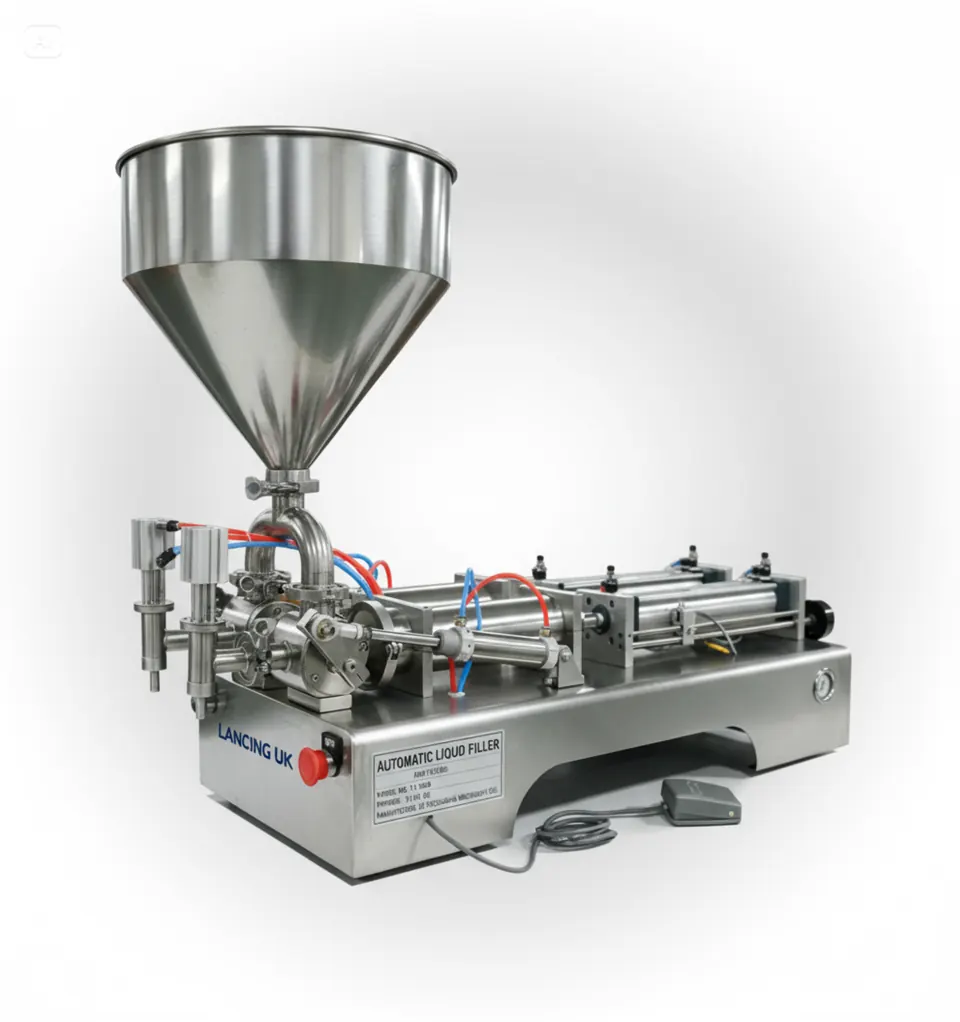
Key takeaways
What this guide helps you decide
- Product difficulty changes hardware and trial work
- Automation adds handling, controls and guarding
- Change parts and product feed can be material costs
- ROI should include labour, giveaway, rejects and capacity
Dosing technology and contact path
Piston cylinders, servo drives, specialised pumps, peristaltic channels, augers, scales and counter-pressure heads have different hardware costs. Corrosion-resistant or hazardous-area components can materially increase the project scope.
Product-contact materials, seals, hoses, nozzles and sanitary or cleanable construction should be specified before budget comparison.
Number of heads and automation level
More filling heads can raise output but also add pumps, cylinders, valves, nozzles, calibration points and cleaning work. The line may need a wider frame, stronger product feed and more accumulation to use those heads effectively.
Automatic equipment adds conveyors, sensors, gating, PLC/HMI controls, guarding and fault handling. Semi-automatic equipment transfers more handling work to operators.
Product feed and ancillary equipment
Hoppers, heated jackets, agitation, transfer pumps, powder feeders, level control, dust extraction, tanks and return systems are often essential to repeatability. They should not be treated as optional afterthoughts.
The same applies to air compressors, chillers, carbonation, extraction or hazardous-area infrastructure where the process requires them.
Pack range and changeovers
A broad range of bottles, jars or pouches may require guide parts, pucks, nozzle adjustments, cylinder modules, screws, funnels and recipes. Fast, repeatable changeovers can justify additional engineering and tooling.
Define the normal range and the rare exceptions separately. It may be cheaper to use two simple solutions than one machine forced to cover every extreme.
Calculate practical return
Compare current labour, giveaway, underfills, spillage, rework, cleaning time and lost sales from limited capacity. Use sustainable hourly output and planned shifts rather than theoretical speed.
Include maintenance, consumables, compressed air, energy, spare parts and operator skill. A reliable machine with simpler changeovers may deliver a better return than the lowest initial quotation.
Project checklist
- Required machine and automation level
- Product feed and utility equipment
- Change parts for every mandatory SKU
- Capping, labelling, coding and conveyors
- Installation, commissioning and training
- Trial, FAT and SAT product costs
- Freight, access and site preparation
- Annual labour, waste and maintenance assumptions