
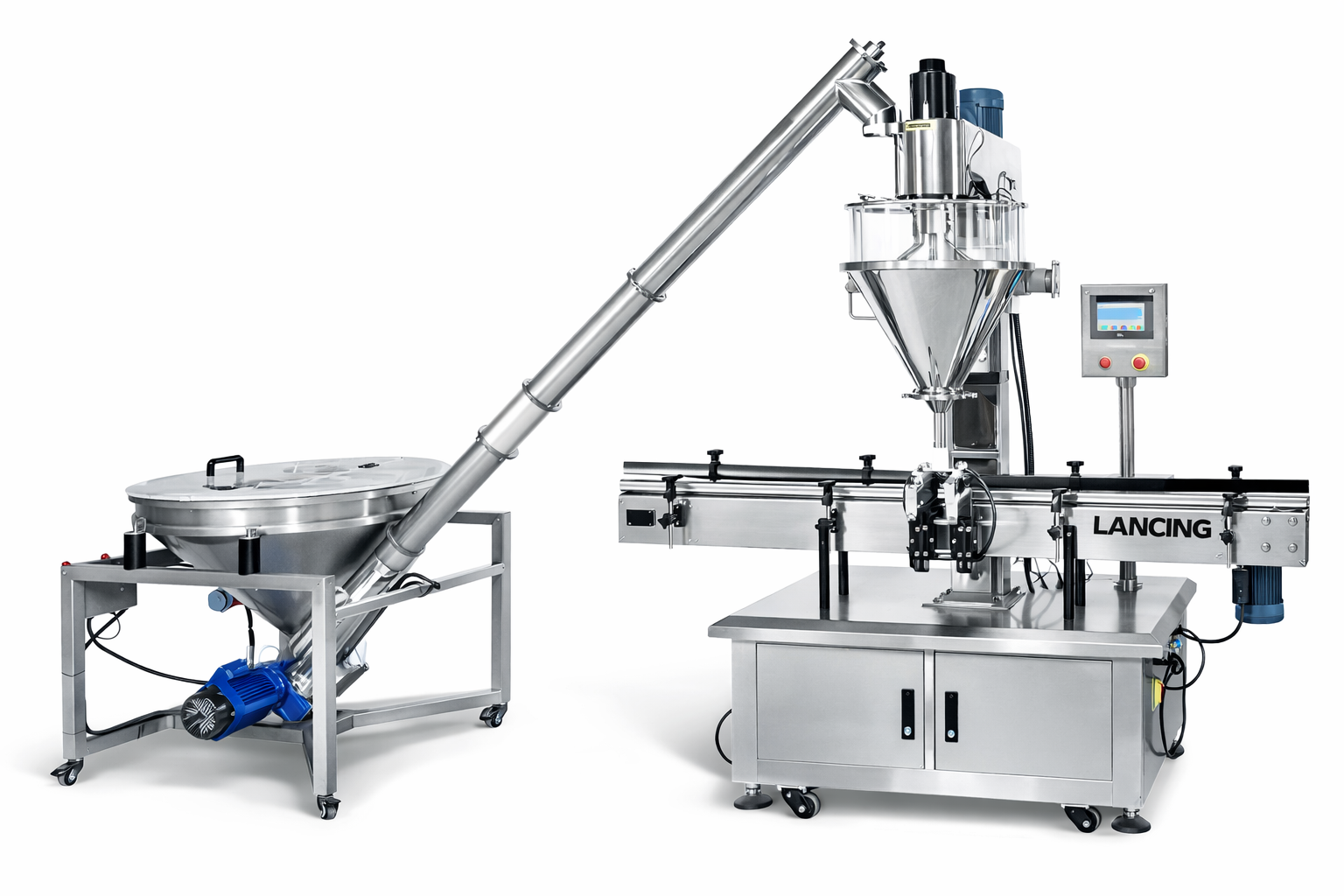
Auger powder filling
A controlled screw meters fine or non-free-flowing powders into the pack.
Explore this routeDry-product dosing
Powder filling depends on bulk density, flowability, dust, aeration and how the product settles after dosing. Fine cohesive powders often point toward auger filling, while free-flowing or irregular products may be better served by weigh systems. The pack opening, extraction and sealing route must be considered at the same time.

Typical products and packs
Compare the principles
Several dosing methods may fill the same nominal product. The practical choice is driven by accuracy, cut-off, cleaning, format range and sustained output.
A controlled screw meters fine or non-free-flowing powders into the pack.
Explore this routeLive weight feedback suits products where density varies or mass accuracy is the priority.
Explore this routeBest reserved for free-flowing granules rather than cohesive fine powders.
Explore this routeThe dose system must be coordinated with film, pouch opening and sealing.
Explore this routeBefore quotation
Beyond the filler
Machines you can compare
Specifications are reference points. Confirm the operating window using the intended product, container and line arrangement.

LU-FM5A
Servo auger powder filler with automatic screw feeder for jars and containers. Review 10–500 g reference range, hopper, utilities and output.
See machine detailsCompare your options
Auger filling machines for powders in jars, bottles, tubs, bags and pouches. Compare screw tooling, feeders, dust control, accuracy and automation.
See optionsWeigh filling machines for oils, liquids, powders and granules. Compare net-weight, pump-and-scale and multihead weighing around accuracy and output.
See optionsGranule filling machines using volumetric cup or weigh dosing for beans, seeds, sugar, coffee, tablets and free-flowing dry products in the UK.
See optionsSachet filling machines for powders, granules, liquids and pastes. Compare dose systems, film, seal type, pack size, hygiene and output requirements.
See optionsPharmaceutical and nutraceutical filling machinery for liquids, serums, powders and supplements. Plan dose control, cleanability, packs and records.
See optionsQuick answers
Typical applications include food powders and ingredients, protein, supplement and nutraceutical powders, cosmetic and household powders. The final decision depends on the real product, dose, container and target output.
Start with the product behaviour, fill range, pack format and sustainable output. Then compare the dosing principle, contact materials, changeover and cleaning against stable dry-product dosing despite density, dust and flow variation.
Yes. Filling can be planned with container infeed, conveyors, capping or closing, labelling, coding, sealing, inspection, accumulation and end-of-line handling.
Send product details and safety data where relevant, fill volumes, container and closure samples or drawings, target output, utilities, cleaning needs, footprint and any existing equipment to be integrated.
Ready to discuss your application?
Tell us what you fill, your fill range, container and target output. We will help you narrow the practical machine options before quotation.
Dry-product behaviour
Powder names do not reliably describe machine behaviour. Fine powders can aerate or bridge, mixed products can segregate, and free-flowing granules can continue moving after the feed signal stops. The selection should begin with representative material and the finished pack.
| Observed property | Effect on the process | Selection evidence |
|---|---|---|
| Flowability and bridging | Determines whether agitation, screw feeding, vibration or another controlled feed is needed. | Representative sample, hopper behaviour, time at rest and response to normal handling. |
| Bulk-density variation | Changes the mass delivered by a fixed volume and can affect both auger and volumetric results. | Density across batches and after transport, aeration or settling, plus the chosen acceptance method. |
| Dust and aeration | Affects pack cleanliness, extraction, settling time, operator environment and checkweighing stability. | Dust observations, product safety information, pack opening and required containment or extraction interface. |
| Particle size and fragility | Influences screw choice, feed damage, segregation and whether weighing is a better comparison. | Particle distribution, breakage limits, mixed inclusions and sample photographs or sieving information where available. |
| Pack geometry | Controls nozzle clearance, dust capture, settling space and container stability. | Smallest opening, pack depth, material stiffness, closure or sealing route and required headspace. |
| Cleaning and product change | Determines access, tooling, dust removal and the practicality of frequent SKU changes. | Changeover frequency, segregation needs, removable parts and acceptable residual product. |
Auger or weigh comparison
An auger filler may suit powders that respond well to controlled screw rotation. A weigh filler may be more useful where live mass feedback, free-flowing particles or density variation dominate. Some projects need a feed-and-weigh combination rather than a single principle in isolation.
Test dose stability, cut-off, dust, product settling and pack presentation across the real range. Record the product condition and the measurement method so results are repeatable.
Specialist dry-product route
powderfillers.co.uk is the preferred Lancing specialist site for auger, weigh, VFFS and complete dry-product line comparisons. Use the enquiry checklist to prepare product, dose and pack information before requesting a trial.
Request a powder-filler reviewFurther buyer questions
These answers clarify the practical boundaries that should be checked before a machine is selected or quoted.
Auger dosing can be effective where controlled screw movement suits the powder, while weighing may be preferred where live mass feedback is central to the acceptance method. Flow, bulk density, dust, settling and pack format should be tested rather than assumed.
Powders with similar descriptions can bridge, aerate, compact, segregate or create dust in very different ways. A representative batch allows the hopper, agitation, feed, dose control and clean-down approach to be assessed under realistic conditions.