How to choose a filling machine
A practical UK guide to choosing filling machinery by product behaviour, fill volume, container, accuracy, output, cleaning and line integration.
See options
Filling machinery answers
Use these answers to understand the main machine principles, performance variables, product trials and line-integration decisions. Final equipment selection should be based on representative product and pack data.
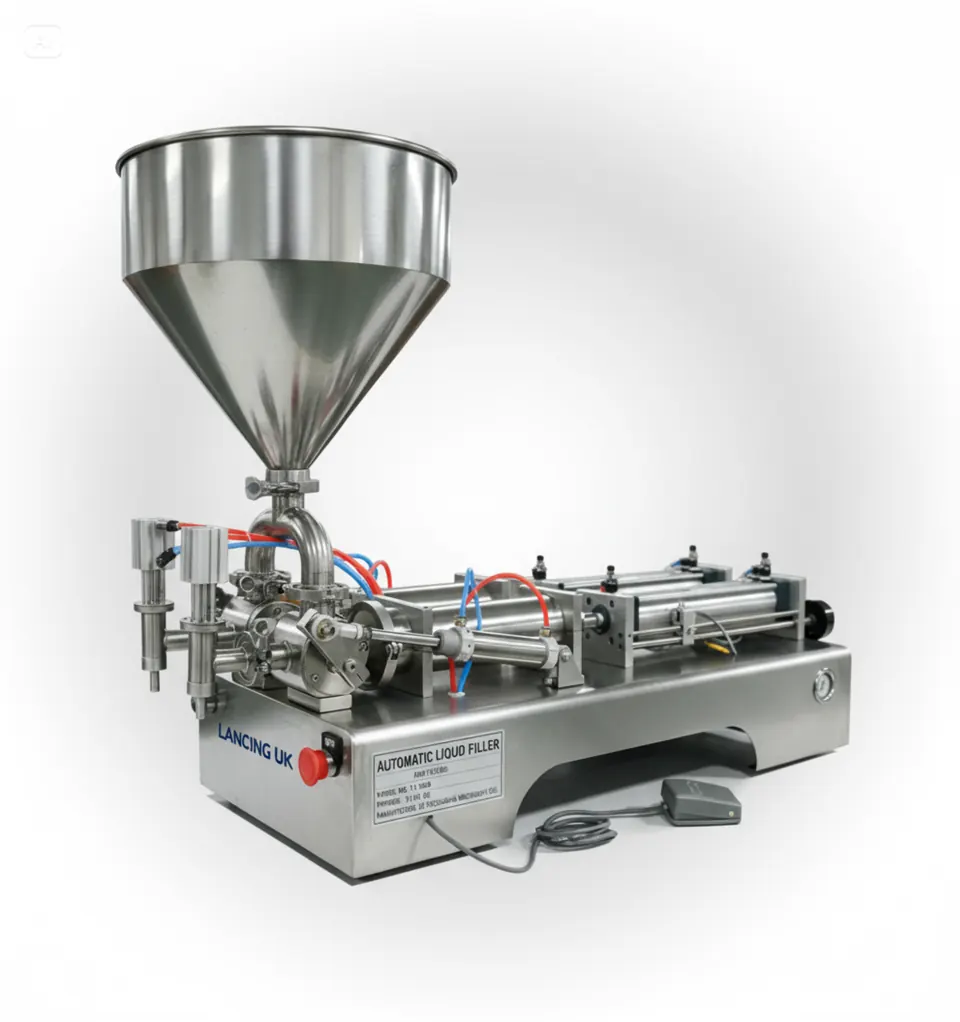
Quick answers
The range includes liquid pump fillers, volumetric and piston machines, paste fillers, peristaltic systems, auger powder fillers, granule and weigh systems, vacuum fillers, carbonated filling equipment, ATEX projects, sachet fillers and complete lines.
Piston systems provide measured displacement and are widely used for viscous products. Pump systems can be more flexible across flow rates, product feeds and dose ranges. Product shear, particles, cut-off, cleaning and accuracy must be compared using samples.
Peristaltic filling keeps product inside replaceable tubing, which can support small-dose work, rapid product-contact changeover and selected hygienic applications. Tube compatibility, life, pressure and dose range still need confirmation.
Volumetric machines control a volume or displacement. Weigh fillers use scale feedback to target net or gross weight. Weight control can compensate for density variation in some applications, but container tare, vibration and filling speed influence the result.
Yes, selected piston, rotor or lobe pump routes can handle suitable particulates. The largest particle, shape, concentration, shear sensitivity, nozzle bore and valve path must be trialled.
Common controls include diving or bottom-up nozzles, staged flow rates, larger nozzle bores, product de-aeration, controlled tank return and careful bottle handling. The best combination depends on the formulation and dose.
No. Published speeds are reference conditions. Sustainable output depends on product flow, fill volume, container handling, machine acceleration, operator intervention, changeovers, rejects and downstream equipment.
Semi-automatic systems suit lower output, varied formats and operator-led production. Automatic systems reduce manual handling and support higher sustained rates, but require stable packs, integration and a larger project scope.
Yes. A line can include infeed, rinsing or unscrambling, filling, cap feeding and application, sealing, labelling, coding, inspection, conveyors, accumulation and end-of-line handling.
ATEX projects address explosive atmospheres created by flammable gases, vapours, mists or dust. The zone, substance group, temperature class, ignition sources, extraction, earthing and complete installation must be assessed by competent parties.
Provide representative production product, containers, closures, labels where relevant, fill targets, temperature, safety data, cleaning method and acceptance criteria. Samples should reflect the worst credible operating condition.
Lancing Ltd is based at Unit 5A Jefferson Way, Thame, Oxfordshire, OX9 3SZ, United Kingdom.
Detailed guidance
A practical UK guide to choosing filling machinery by product behaviour, fill volume, container, accuracy, output, cleaning and line integration.
See optionsUK filling machine buyer’s guide covering piston, pump, peristaltic, auger, weigh, vacuum, automation, trials, quotations and acceptance testing.
See optionsUnderstand filling machine cost drivers in the UK, including dosing technology, automation, heads, product feed, change parts, guarding and integration.
See optionsCompare semi-automatic and automatic filling machines by output, labour, flexibility, footprint, changeover, cost and future production growth.
See optionsGuide to filling machine nozzles including anti-drip, shut-off, diving, bottom-up, overflow and wide-bore options for liquids, pastes and particles.
See optionsPlan filling line integration across infeed, filling, capping, labelling, coding, inspection, conveyors, controls, FAT, SAT and production handover.
See optionsReady to discuss your application?
Tell us what you fill, your fill range, container and target output. We will help you narrow the practical machine options before quotation.
Technical answers
The question library gives each selection, application and integration topic a clear owner and links to deeper technical guidance.
Find answers organised by buyer task rather than keyword.
Open the resourceReview recipes, format parts, cleaning and trial boundaries.
Open the resourceMap the complete product path, materials and cleaning boundary.
Open the resource