
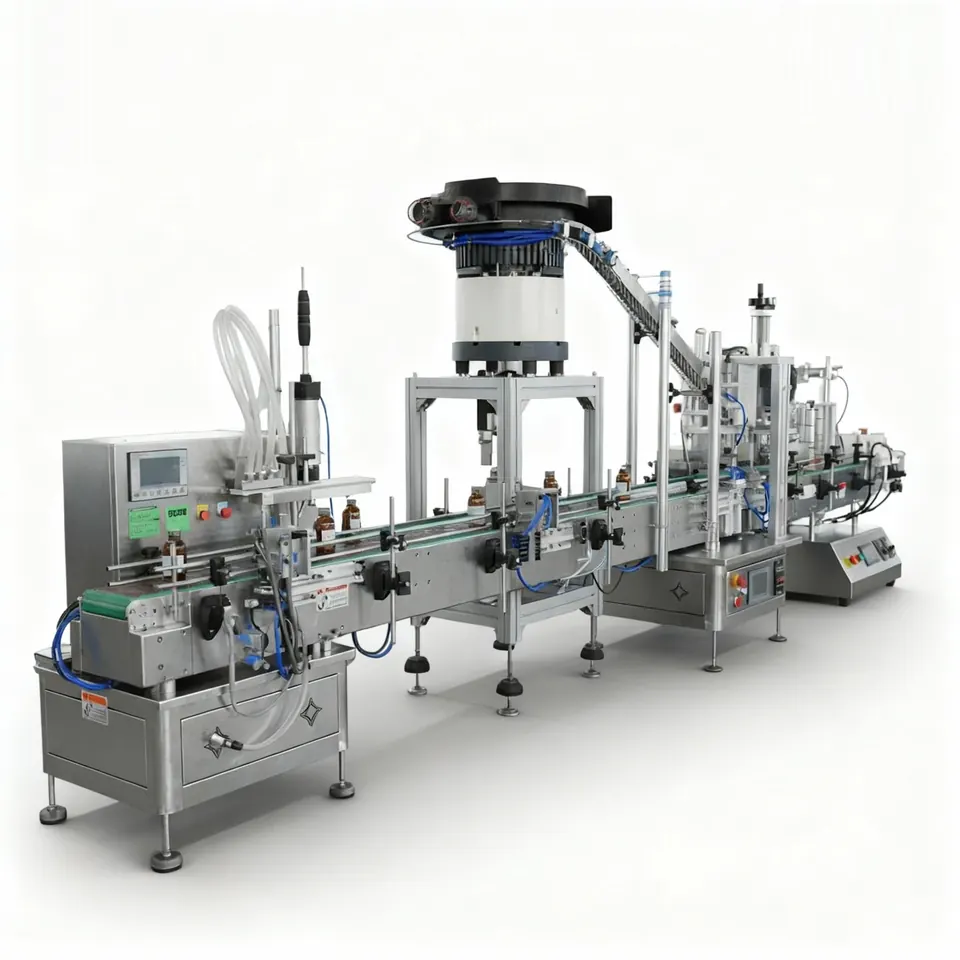
Key decisions
Design around the least forgiving container and line state
- Use production packs, not only nominal drawings, to assess dimensional variation and stiffness.
- Define how containers are oriented, pitched, stopped, supported and released at the filler.
- Provide accumulation that protects the filler from normal upstream and downstream variation.
- Check nozzle clearance, neck opening, headspace and pack deformation during filling.
- Include format change, sensor targets, rejects and recovery with containers already inside the line.
Classify the container before selecting the transport method
Record base footprint, height, neck position, opening, centre of gravity, wall stiffness, surface finish and whether the empty pack is prone to tipping, scuffing, squeezing or static. Lightweight containers can behave differently once filled. Flexible pouches and large drums require different support from rigid bottles or jars.
Inspect normal manufacturing variation and packs after storage or transport. A dimension that is acceptable to the packaging supplier can still affect a tight guide or sensor target. The application review should identify which dimensions are functionally critical to the filling and downstream process.
| Handling function | Design questions | Evidence to prove |
|---|---|---|
| Infeed and orientation | Does the pack arrive upright and in the required orientation? | Representative packs through normal upstream delivery and accumulation. |
| Pitch control | How is one container separated and positioned for each fill cycle? | Repeatable stop or timing across speed changes and interruptions. |
| Support at fill | Is base, body or neck support needed during nozzle entry or product impact? | No contact damage, tipping, deformation or movement during the dose. |
| Accumulation | How much normal variation can be absorbed without stopping the filler? | Blocked and starved tests with realistic upstream/downstream behaviour. |
| Release and transfer | Can the filled pack leave cleanly without slosh, spill or collision? | Stable transfer at intended fill level and product condition. |
| Reject and recovery | How are missing, misfilled or interrupted packs identified and removed? | Defined tracking and operator recovery without ambiguous containers. |
Control position without damaging the pack
Guides should stabilise the container while allowing normal variation. Excessive pressure can deform lightweight bottles, scuff decoration or create friction that changes line flow. Too much clearance can allow necks to miss the nozzle. Confirm adjustment references and change parts for each format.
Where the opening is offset or the pack shape is asymmetric, orientation may be required before filling. Neck handling can help unstable containers but must suit the neck finish and downstream closure process. Use samples from the actual packaging supply route rather than only precision prototypes.
Match nozzle movement to container movement
Nozzle entry, bottom-up filling or follow-fill motion needs controlled container position and clearance. Check the narrowest opening, maximum container height and likely dimensional variation. The nozzle must withdraw without dragging product across the neck or colliding when a container is absent or mispositioned.
Product impact can move an empty lightweight pack. Fill profile, nozzle diameter, initial flow and support should be considered together. For foaming products, headspace and nozzle depth may set the cycle. For hot product, container material and stability after heating may change transfer behaviour.
Use accumulation to protect sustainable output
A filler that stops for every upstream gap or downstream hesitation will not achieve its isolated cycle rate. Define the normal variation of rinser, unscrambler, capper, labeller and case packing equipment, then provide controlled accumulation where appropriate. Accumulation is a process buffer, not a substitute for resolving chronic faults.
The control system should distinguish starved, clear, running and blocked states. Test restart with packs in different zones and decide how partly processed containers are handled. The controls and data guide covers line-state and tracking requirements.
Plan format change and recovery
Create a format matrix for guides, belts, screws, stops, neck rails, sensors, nozzles and recipe values. Identify adjustment datums and prevent a wrong change part from being used where practical. Check the first and last container through each transition.
After a jam or emergency stop, operators need a defined method for containers already inside the line. Decide which packs can continue, which require inspection and which must be rejected. Clear status and physical access reduce the temptation to push ambiguous packs back into production.
Container-handling data for quotation
- Dimensioned pack drawings and production samples.
- Empty and filled weight, stability and stiffness.
- Neck opening, finish, headspace and product impact.
- Required orientation and decoration constraints.
- Full format range and credible variation.
- Upstream source and downstream machine speeds/states.
- Accumulation, reject and interrupted-pack strategy.
- Change parts, settings and operator-access requirements.