
Key decisions
Start with the process variable that must be controlled
- Classify the product by flow, entrained solids, aeration, temperature sensitivity and cleanability.
- Define whether the commercial requirement is a repeatable volume, a target net weight, a liquid level or controlled dry-product dosing.
- Test the smallest and largest required dose in the least forgiving container, not only the easiest format.
- Compare replenishment, cleaning, changeover and operator intervention as part of the technology decision.
- Keep product feed, nozzle behaviour, container handling and downstream interfaces inside the same application review.
Positive-displacement routes for liquids and pastes
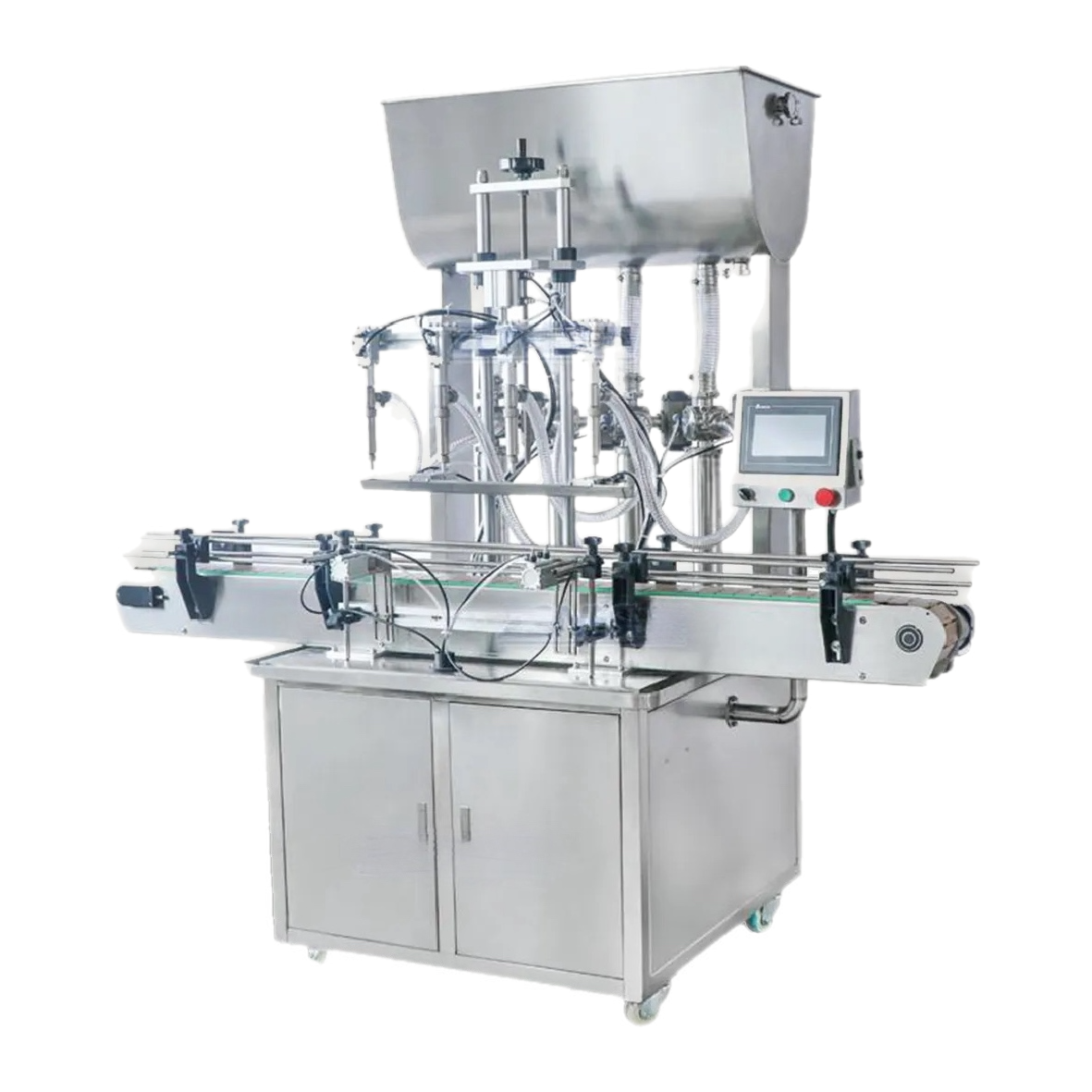
A piston filler meters a defined displacement and can be a practical route for many free-flowing liquids, viscous products and products that need a controlled suck-back at the nozzle. The application still depends on valve passages, product inclusions, temperature, seals, nozzle geometry and the way product is supplied to the dosing cylinder.
Pump filling covers several distinct principles rather than one universal method. Gear, lobe, rotor and other pump types interact differently with viscosity, shear, inclusions and pressure. The pump should therefore be selected around product behaviour and the required hygienic or clean-down method, not simply because the product is described as liquid or paste. Compare the relevant piston filling and pump filling routes before fixing the machine architecture.
| Method family | Useful selection question | Boundary to prove |
|---|---|---|
| Piston filling | Can a controlled displacement move the complete product range through the valve and nozzle? | Product inclusions, temperature change, seal compatibility, cylinder range and clean-down access. |
| Pump filling | Which pump characteristic best matches viscosity, shear sensitivity, solids and feed pressure? | Priming, run-dry behaviour, product heating, residual product and control response. |
| Peristaltic filling | Is keeping product inside replaceable tubing valuable for this low-volume liquid duty? | Tubing compatibility, tube life, calibration drift, dose range and nozzle control. |
| Vacuum or level filling | Is a consistent visual fill level more important than a fixed metered dose? | Container rigidity, neck finish, foaming, product recovery and vacuum suitability. |
Dry-product dosing needs a different decision path
Powders and granules should not be forced into a liquid-filling comparison. An auger controls a volume of product through screw rotation and is often considered for powders that can be presented consistently to the tooling. Gravimetric or weigh-based systems measure mass and can be advantageous where bulk density varies or net weight is the governing quantity. Free-flowing granules may suit different feeders from cohesive powders.
The key evidence is the behaviour of the actual material: bulk-density variation, dust, compaction, particle damage, segregation, bridging and the effect of hopper level. Use representative production material and packaging during the product trial.
Volumetric, gravimetric and level control answer different questions
A volumetric system controls a volume or displacement. A gravimetric system controls measured mass. A level filler controls the product level in the container. These outputs may look similar on a finished pack, but the acceptance method and the factors that disturb the result are different.
Where product density is stable and the pack declaration is compatible with volumetric control, a volumetric route may be direct and productive. Where density variation materially affects the commercial result, weighing can provide a more relevant feedback variable. The detailed volumetric versus gravimetric comparison explains how to structure that choice without assuming one technology is universally more accurate.
The machine is only one part of the filling process
A strong technology choice can still underperform when the filler is starved, the product temperature changes, containers arrive inconsistently or the downstream machine blocks. Define the product source, head pressure or feed pump, buffer capacity, container pitch, reject route, line states and operator replenishment method.
The filling line integration guide should be used alongside the dosing comparison so the chosen filler can start, stop, hold, recover and change format as part of the complete line rather than as an isolated machine.
Use evidence to narrow the shortlist
Begin with a written application matrix covering every product, dose, container and closure that is genuinely required. Mark the hardest product and hardest pack, then use the enquiry review to identify two or three plausible principles. A trial should record fill behaviour, nozzle cut-off, product recovery, pack cleanliness, repeatability and the operator tasks required to sustain the run.
Do not select from a generic video alone. Record what was tested, what remains an assumption and which conditions must be confirmed during FAT or SAT. This keeps the final recommendation tied to evidence rather than terminology.
Technology comparison information to prepare
- Product name, composition information and safety data where relevant.
- Flow behaviour at minimum and maximum operating temperature.
- Particles, fibres, gas, foam, stringing, dripping or shear sensitivity.
- Minimum, normal and maximum dose with units and tolerance method.
- Container drawings or samples, neck opening and stability.
- Batch size, production pattern and target sustainable output.
- Cleaning, product recovery, allergen or cross-contamination controls.
- Upstream feed, downstream equipment, utilities and available footprint.