
Key decisions
Decide what the process must measure and protect
- Confirm whether the finished pack is controlled commercially by volume, mass or visual level.
- Measure how product density changes with temperature, aeration, settling, formulation and batch.
- Include container tare variation, vibration, draughts and conveyor disturbance in a weighing review.
- Include calibration, refill conditions and product feed stability in a volumetric review.
- Compare sustainable good-pack output rather than an isolated dosing cycle.
What volumetric filling controls
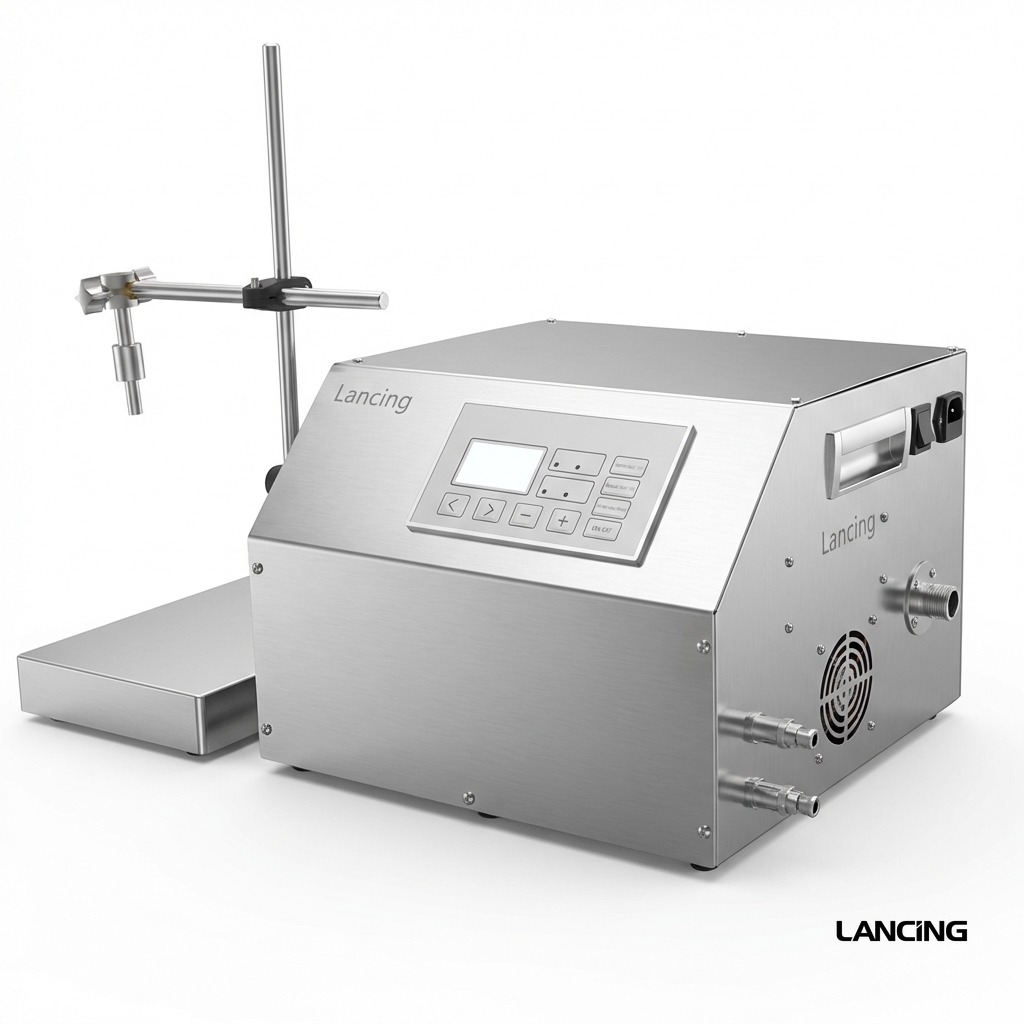
Volumetric filling meters a defined volume using a displacement, timed flow, flow measurement or another controlled volume-based method. Piston and some pump or flowmeter systems can fall within the broader volumetric family, although their operating characteristics differ. The process can be direct when the product is sufficiently consistent and the acceptance requirement is expressed in volume.
The result can move when product temperature, entrained air, viscosity, feed pressure or priming changes the way the liquid reaches the metering element. The trial should therefore include normal replenishment and operating conditions, not only a short run from a full, settled hopper. Review the wider volumetric filling machine range for relevant machine families.
What gravimetric filling controls
Gravimetric filling measures mass through a load cell or weighing system. It can compensate for density variation because the controlled result is weight rather than an assumed relationship between volume and mass. Bulk liquid, powder, granule and larger-container applications may use different mechanical arrangements, but all require a stable and properly managed weighing process.
Container tare, vibration, product-in-flight, dribble control, air movement and the time allowed for the reading to settle can influence the result. A weigh filler therefore needs more than a load cell: the feed device, coarse and fine dosing sequence, container support and software logic must work together. Compare weigh filling options with the actual pack and material.
| Decision factor | Volumetric route | Gravimetric route |
|---|---|---|
| Primary controlled quantity | Volume, displacement or measured flow. | Mass measured by the weighing system. |
| Density variation | May change mass at the same volume and should be quantified. | Mass control is not dependent on converting from assumed density. |
| Container influence | Neck, stability and fill dynamics affect handling and nozzle selection. | Tare variation, support, vibration and settling also affect measurement. |
| Speed constraint | Metering, nozzle behaviour and container transfer determine the cycle. | Coarse/fine feed, in-flight correction and settling can determine the cycle. |
| Acceptance evidence | Reference measure or verified volume/mass conversion under stated conditions. | Verified weights, tare method and treatment of start-up or rejected packs. |
| Best comparison basis | Actual product across the required dose and operating range. | Actual product and containers across tare, feed and environmental conditions. |
Density variation is an application question, not a label
Do not assume a product has constant density because the formulation name is stable. Temperature, whipping, dissolved gas, settling, solids distribution and transfer pumping can change the relationship between volume and mass. For dry products, compaction and hopper history can alter bulk density even when the ingredients are unchanged.
Take representative samples at the start, middle and end of a batch or shift where those conditions are relevant. Record temperature and product preparation. The result will show whether density variation is commercially significant enough to favour direct weighing or whether a volumetric method remains practical.
Compare the complete cycle and operating burden
A fast isolated dose does not prove useful line output. Include container arrival, tare acquisition where applicable, coarse and fine dosing, nozzle movement, settling, check or reject logic, operator replenishment and downstream transfer. Where a checkweigher is used after volumetric filling, define whether it monitors, rejects or actively corrects the process.
Cleaning and changeover also differ. Product-contact pumps, cylinders, hoppers, feeders, weigh pans and chutes must be assessed against the actual hygiene and product-recovery requirement. Use the cleaning and changeover guide to compare access and verification.
Build an acceptance method before choosing
State the target quantity, tolerance, sample size, measurement device, container tare treatment, product condition and run duration before the trial. Separate individual-pack limits from process-centre or average controls where the business uses both. Record how start-up, refills, changeovers and faults are treated.
The accuracy and repeatability guide provides a structured framework. The purpose is not to declare one method inherently superior; it is to prove which controlled variable gives the most robust and supportable result for the application.
Evidence for a volumetric or gravimetric decision
- Declared quantity and internal quality limits.
- Product density results under representative operating conditions.
- Container tare range and stability.
- Dose range, batch size and required production pattern.
- Product feed arrangement and refill method.
- Measurement equipment and traceability route.
- Cleaning, recovery and changeover expectations.
- Required check, reject, feedback and data-recording functions.