
Direct answer
When is a gravity filling machine a sensible option?
A gravity filling machine is usually considered for a still liquid that flows predictably from a controlled source and can be stopped cleanly at the nozzle. Suitability depends on viscosity at the real filling temperature, foam, particles, bottle neck access, product compatibility, the required fill basis and how consistently the upstream tank or supply maintains the inlet condition.
- Confirm whether the commercial requirement is a measured volume, a visible level or another verified quantity.
- Define the product source, normal liquid level and how the supply will be replenished without changing the fill result.
- Test the smallest dose and least stable bottle, not only the easiest format.
- Observe start-up, steady running, refill and end-of-batch conditions.
- Compare gravity filling with flowmeter, piston, pump, vacuum and weigh routes before fixing the machine type.
Gravity describes the product movement, not the complete measuring method
In a gravity-fed system, product pressure at the filling valve is created mainly by the height and condition of the liquid supply rather than by a positive-displacement dosing element. The machine still needs a controlled way to open and close flow, locate the pack and determine when the fill is complete. That completion point may be based on time, a programmed valve sequence, a measured quantity or a level-filling arrangement, depending on the design.
This distinction matters when quotations are compared. A machine described as a gravity filler may be intended to deliver a timed dose, while another may be designed to produce a repeatable liquid level. Those outcomes are not interchangeable. State the finished-pack acceptance method before choosing the filling principle.
Keep supply head and product condition inside the specification
Gravity flow changes when the pressure at the valve changes. Tank level, pipe or hose length, valve restriction, temperature, filtration and product aeration can all affect the inlet condition. A small local balance tank may hold the supply within a defined range; a remote vessel may need level control, a transfer pump or a pressure-management arrangement. The correct boundary should be shown on the line layout and included in the trial.
If the product separates, settles or changes viscosity, gravity alone does not solve the conditioning problem. Agitation, recirculation or temperature control may be required, but each can introduce air, shear or heat. The product-feed systems guide explains how to specify this upstream route without treating it as somebody else’s machine.
Use product behaviour and bottle geometry to screen suitability
| Selection factor | Why it matters to gravity filling | Evidence to collect |
|---|---|---|
| Flow behaviour | The liquid must pass the valve and nozzle predictably across normal temperature and batch variation. | Representative product at minimum and maximum filling temperature. |
| Foam and aeration | High entry velocity or a falling stream can build foam and delay closure or labelling. | Foam height, settling time, headspace and nozzle position during a realistic run. |
| Particles or fibres | Solids can obstruct passages, alter cut-off or settle in the supply path. | Worst-case product sample and the required passage size. |
| Container opening | The nozzle must enter or align without striking the neck, thread or shoulder. | Production bottles, drawings and normal moulding variation. |
| Container rigidity | Flexible packs can deform under guides, nozzle contact or product impact. | Empty and filled pack handling through start, stop and restart. |
| Quantity basis | A timed gravity dose, a measured dose and a level fill use different controls and verification. | Declared quantity, tolerance, test instrument and visual presentation requirement. |
Control the final part of the dose, not only the main flow
Most fill-quality problems occur at the start or end of the dose. The nozzle and valve arrangement should prevent splash on opening, avoid an uncontrolled falling stream and stop without a tail or drip entering the closure area. Staged flow, positive shut-off, suck-back or nozzle movement may be considered, but the choice must suit the liquid and be proved with the real container.
For products that foam, compare gravity delivery with a controlled pump or piston profile and review the bottom-up filling guide. A slower final stage may improve cut-off and pack cleanliness even when the main fill can run faster.
Separate gravity dosing from vacuum or overflow level filling
Gravity supply can be used in more than one architecture, but a vacuum or overflow filler normally aims to create a repeatable visible level in suitable rigid containers. A gravity dose may instead target a programmed quantity under controlled conditions. If container internal volume varies, equal volumes can show different levels; if appearance is the main requirement, a level-filling route may be more appropriate. Use the level versus volumetric guide to define which result the customer actually needs.
Choose automation and head count from sustainable line output
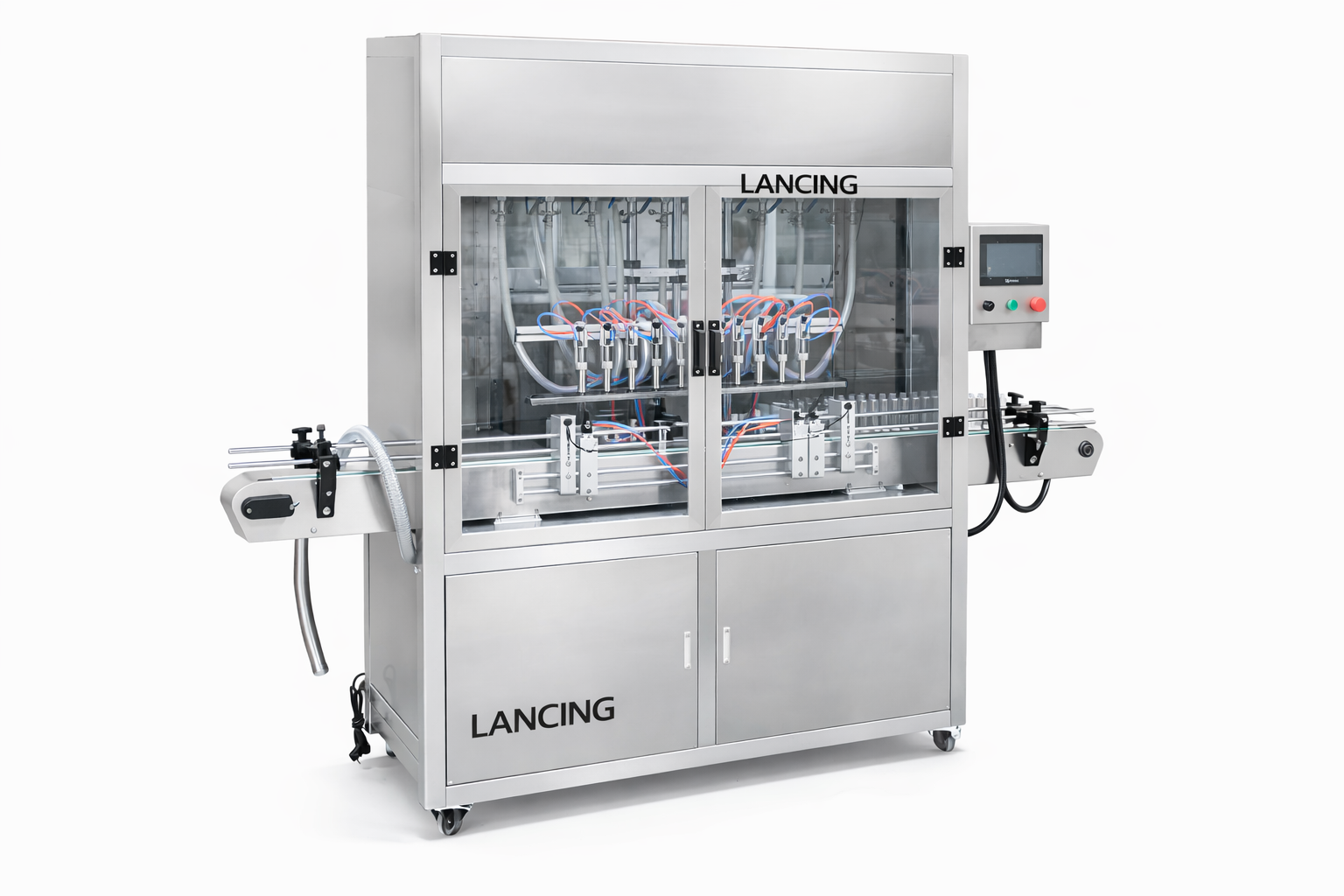
A single valve can suit operator-led batches or trial work. Twin and multi-head layouts can raise output when product supply, bottle gating, nozzle alignment and downstream equipment are balanced. Adding heads does not multiply production automatically: the shared tank, manifold, replenishment rate and container pitch must support every head at the same condition.
For conveyorised projects, use the single-head versus multi-head guide and verify the complete cycle, including bottle arrival, fill, release, refill, blockages and recovery.
Map the entire wetted route before agreeing cleaning
Include the source tank, level devices, valves, manifolds, hoses, nozzles, drains and any return path. Decide how residual product is recovered, how the system is emptied, which components are removed and how the next product is released. A clean-looking nozzle does not prove the upstream supply is clean. The required method may be manual strip-down, controlled flushing, clean-out-of-place or a validated clean-in-place route where the equipment is designed for it.
Information to provide for a gravity-filler review
- Product identity, safety data where relevant and representative samples.
- Viscosity or flow behaviour at the actual filling temperature.
- Foam, air, solids, settling, corrosiveness and cleaning restrictions.
- Minimum, normal and maximum fill with the required acceptance method.
- Container samples, opening dimensions, material, stability and closure.
- Batch size, production pattern and sustainable good-pack target.
- Product source, vessel height, refill method and available utilities.
- Required capping, labelling, coding, inspection and accumulation scope.